
A Review of Seeing Systems by Barry Oshry
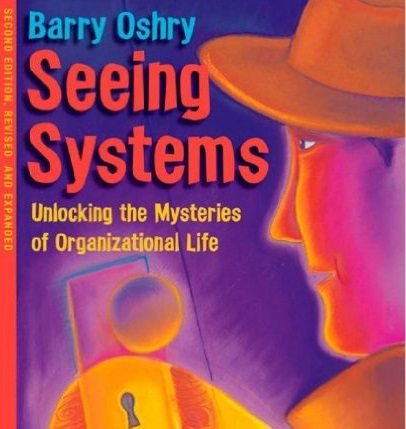
Throughout our lives, we move in and out of a range of complex organisational structures and social systems that include our work, family, and the various teams, groups or societies we belong to. Understanding the complex relationships and power struggles that take place within these systems can often pass us by as we attempt to fulfil our role and duties.
Seeing Systems by Barry Oshry provides a unique and clever insight into the mysteries of power and powerlessness in social systems that provide an explanation of why we behave the way we do in a variety of roles.
Based on over 30 years’ of observations, the book describes how our behaviours and responses are based on our own view of the world, often with little understanding of what others in different roles in the system may be experiencing.
Oshry introduces us to three key players and the customer:
- Tops (Executives): burdened by unmanageable complexity and fire fighting
- Middles (Managers): torn and confused between conflicting demands and feeling isolated from everyone else
- Bottoms (Workers): oppressed by distant and uncaring tops, and distracted from putting energy into delivery
- Customers: feeling done to by a non-responsive delivery system, feeling disgruntled, and not engaged as an active partner
The book takes us on a journey, outlining how we constantly move in and out of the different roles either as a top, middle or bottom, and how easily we adopt the habits and behaviours attributed to these roles. Oshry argues that we find ourselves caught in a pattern of behaviour or responses that are not as personal as we would like to think they are, but rather systemic and shaped by the structure and process of the systems we find ourselves in.
The book is written in a non-traditional format and requires a fair bit of concentration to keep track of the various roles and stages, but the basic premise of the book is certainly one that I can relate to. Indeed, I found myself smiling as I recognised many of the patterns and behaviours displayed by Tops, Middles and Bottoms.
Whilst I found the book a challenging read it did provide me with useful insights into the complexities of organisational life, reminding me that in order to be a good leader, co-worker and team player we need to see the world as others see it (or see us). The concept of falling into a pattern of behaviour and assumption based on which role or position you fulfil is one that I think many of us can relate to.
The concept of Tops, Middles and Bottoms was a new concept to me, but it is now a memorable one thanks to Oshry’s unusual writing style and insight. And to stick with Oshry’s unusual theatre style, this poem by Rabbie Burns came to mind:
To a Louse
O wad some Pow’r the giftie gie us
To see oursels as others see us
It wad frae monie a blunder free us
An’ foolish notion
What airs in dress an’ gait wad lea’e us
An’ ev’n Devotion
In modern English, I think this provides a thought provoking piece of prose for all leaders, co-workers and team players.
Oh, that God would give us the very smallest of gifts
To be able to see ourselves as others see us
It would save us from many mistakes
and foolish thoughts
We would change the way we look and gesture
and to how and what we apply our time and attention.
But perhaps Tops, Middles and Bottoms is easier to remember!